

Discover The Skin Microbiome
Understanding how baby skin develops — and how to care for it gently.


Why microbiome-friendly skincare matters
Today, sensitive and reactive skin is no longer the exception — it is increasingly common from early life onwards. Many babies and children experience dryness, irritation, redness or recurring discomfort as their skin adapts to the outside world. For parents, this can feel confusing, especially when products designed to help sometimes seem to make skin less comfortable instead of more.
The impact of modern skincare
One reason for this shift is that some modern skincare routines — even those labelled gentle — can unintentionally disrupt the skin’s natural protective systems. Over-cleansing, high-pH formulas, harsh surfactants, antibacterial ingredients and synthetic fragrance may weaken the skin barrier and disturb the delicate balance of the skin microbiome.
When this happens, skin becomes:
• less able to retain moisture
• more reactive to everyday stressors
• more prone to cycles of flare and recovery
Microbiome-friendly approach
Microbiome-friendly skincare starts from a different principle. Rather than overriding the skin’s natural processes, it supports what the skin is still learning to do — strengthening the barrier, respecting natural pH and helping beneficial microbes thrive so skin can regulate and protect itself more effectively.
This approach is especially important in early life, when the skin microbiome and barrier are still developing long-term resilience.
The skin microbiome, the barrier & pH


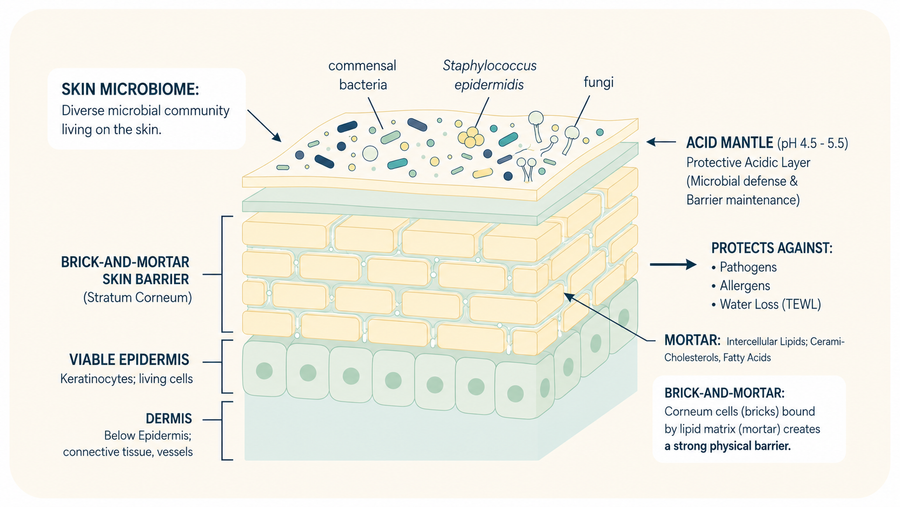
Healthy skin depends on three interconnected systems working together in balance.
- The skin barrier, which protects and retains moisture
- The skin microbiome, a living ecosystem of beneficial microorganisms
- The skin’s natural pH, which creates the environment these systems need to function
When one of these systems becomes disrupted, the others are affected too. A weakened barrier makes it harder for beneficial microbes to thrive. Changes in pH can favour less helpful bacteria. Over time, this imbalance can lead to dryness, sensitivity and reduced skin comfort.
Microbiome-friendly skincare is designed to support all three systems together — looking at skin as an ecosystem rather than addressing individual skin concerns in isolation.
Baby Skin: Why It’s Different


Baby skin is not simply a smaller version of adult skin. Structurally and functionally, it is still developing — and therefore more vulnerable to disruption.
Compared with adult skin, baby skin is thinner, more permeable, quicker to lose moisture, lower in natural lipids and moisturising factors, less efficient at regulating pH, and supported by a microbiome that is still forming.
Because of this, even products that are well tolerated by adults may be too harsh for developing skin.
Baby Skin vs Adult Skin
| Aspect | Baby Skin | Adult Skin | Why This Matters |
|---|---|---|---|
| Skin thickness | Significantly thinner outer layer | Thicker, more robust barrier | Baby skin allows moisture loss and irritants to penetrate more easily |
| Barrier function | Still developing and less resilient | Fully formed and stable | Disruption happens faster and recovery takes longer in baby skin |
| Water loss | Higher | Lower | Baby skin dries out more easily and needs barrier support |
| Natural lipids | Lower lipid content | Higher lipid reserves | Fewer lipids are available to hold skin cells together, resulting in a weaker barrier and increased moisture loss. |
| NMFs | Immature and limited | Fully developed | Skin struggles to maintain hydration on its own |
| Gland activity | Low activity | Fully active | Reduced self-regulation of moisture and pH |
| Skin pH | Higher and less stable | Stable and slightly acidic | Less favourable environment for beneficial microbes |
| Microbiome | Immature and still forming | Stable and diverse | Easily disrupted by harsh products and routines |
| Reactivity | High | Lower | Baby skin responds more easily and strongly to stressors |
The first three years


The first three years of life represent a critical window for skin microbiome development.
From birth through early childhood, the skin microbiome is actively forming, diversifying and becoming more stable. During this time, it helps “train” the skin — supporting barrier development, shaping immune responses and contributing to long-term resilience.
The developing skin microbiome is shaped by many factors including birth method, skin-to-skin contact, feeding, bathing routines and everyday environmental exposure. Gentle skincare during this period helps support a balanced microbial environment as skin matures.
Sensitivity during this time is common and expected. The skin is not failing — it is learning. Gentle, consistent care helps support this natural process, promoting comfort now and resilience later.
Microbiome & Skin Development Timeline

Birth & First Weeks
The barrier is thin, microbiome just forming, pH still unstable. Skin is easily disrupted. Support with minimal products, delayed first bath and skin-to-skin contact.

3 - 12 Months
Barrier strengthens and microbiome becomes more diverse. Moisture retention improves but skin still reacts quickly to disruption. Support with gentle cleansing and consistent moisturising.

1 - 3 Years
Microbiome matures further and begins to resemble adult skin. Barrier and pH become more stable. Continued microbiome-friendly care supports long-term resilience.
When skin is out of balance


When the skin barrier weakens or the microbiome becomes disrupted, the skin’s protective ecosystem cannot function as effectively.
Common signs include:
- dryness or rough texture
- redness or visible irritation
- itch or discomfort
- increased sensitivity
These signs signal that the microbiome and barrier need support — not suppression. Continuing to use disruptive products may prolong imbalance, while microbiome-friendly care helps restore comfort more effectively.
Caring for the skin microbiome


Gentle Cleansing
Cleansing should remove impurities without stripping natural oils or disrupting beneficial microbes. Mild, pH-balanced formulas — especially oil-based or balm-to-milk cleansers — help maintain barrier lipids and support microbiome balance.

Moisturising
Moisturising strengthens the skin barrier and supports hydration, creating the conditions beneficial microbes need to thrive. Well-hydrated skin is more comfortable and more resilient.

Microbial exposure
Skin-to-skin contact, everyday family interaction and gentle environmental exposure support microbial diversity — an important marker of resilient skin.

Minimising disruption
Avoiding harsh soaps, antibacterial washes, synthetic fragrance and unnecessary preservatives helps protect the developing skin ecosystem.
Emerging research highlights connections between gut health and skin balance. While skincare works directly on the skin surface, overall wellbeing may also influence microbiome stability over time.
Certified microbiome-friendly


“Certified microbiome-friendly” means a formula has been independently tested to confirm it supports — rather than disrupts — the skin’s natural microbial balance. Certification confirms that products respect beneficial bacteria, avoid unnecessarily disruptive ingredients and support the skin barrier and natural pH environment.
For parents of sensitive or reactive skin, certification removes uncertainty — offering reassurance that products are designed to work with the skin’s biology, not against it.
Kind to Biome® Certified
BioGaia® Skincare products have been independently tested by Kind to Biome® and shown to be kind to the skin’s natural microbiome.
This gives parents extra reassurance that each formula is designed to respect delicate skin and support its natural balance.